ObjectRoleModel
Last edit December 10, 2011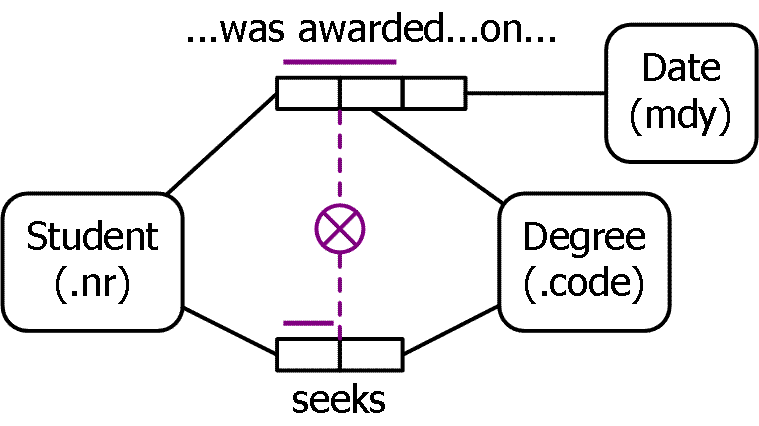 From http://www.orm.net/ : Object Role Modeling (ORM) is a powerful method for designing and querying database models at the conceptual level, where the application is described in terms easily understood by non-technical users. In practice, ORM data models often capture more business rules, and are easier to validate and evolve than data models in other approaches.
Invented by TerryHalpin, now at the part of MicroSoft that used to be VisioCorp.
Terry Halpin did not invent ORM, ORM evolved from the NAIM notation. Terry Halpin established the formal foundation for ORM. See http://www.ormcentral.com/HistoryOfORM.htm -- jMM
Personally, I find ORM diagrams useful when modelling what most sane people would use UnifiedModelingLanguage ClassDiagrams for. -- JohannesBrodwall
What I like about an ORM diagram is that it is easy to evolve. You can start with a simple sketch, and then just keep adding things as you go along. In constrast, UML and E-R tend to require modification as they evolve, rather than addition. So ORM is a better tool to use while designing, whereas UML and E-R may be better for expressing the results of the design, as they are more compact and more familiar to developers and DBAs. -- KrisJohnson
see also ObjectRoleModeling.
From http://www.orm.net/ : Object Role Modeling (ORM) is a powerful method for designing and querying database models at the conceptual level, where the application is described in terms easily understood by non-technical users. In practice, ORM data models often capture more business rules, and are easier to validate and evolve than data models in other approaches.
Invented by TerryHalpin, now at the part of MicroSoft that used to be VisioCorp.
Terry Halpin did not invent ORM, ORM evolved from the NAIM notation. Terry Halpin established the formal foundation for ORM. See http://www.ormcentral.com/HistoryOfORM.htm -- jMM
Personally, I find ORM diagrams useful when modelling what most sane people would use UnifiedModelingLanguage ClassDiagrams for. -- JohannesBrodwall
What I like about an ORM diagram is that it is easy to evolve. You can start with a simple sketch, and then just keep adding things as you go along. In constrast, UML and E-R tend to require modification as they evolve, rather than addition. So ORM is a better tool to use while designing, whereas UML and E-R may be better for expressing the results of the design, as they are more compact and more familiar to developers and DBAs. -- KrisJohnson
see also ObjectRoleModeling.
CategoryModeling