ConceptsTechniquesAndModelsOfComputerProgramming
Last edit November 14, 2011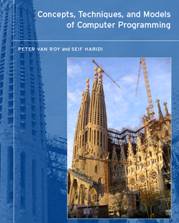
- Concepts, Techniques, and Models of Computer Programming by PeterVanRoy and Seif Haridi
- Publisher: The MIT Press (March 1, 2004)
- ISBN 0262220695, ISBN 978-0262220699
- http://www.info.ucl.ac.be/~pvr/book.html
- ProgrammingBookAcronym: CTM
- The book is organized around programming concepts. It starts with a small language containing just a few concepts. It shows how to design, write programs, and reason in this language. It then adds concepts one by one to overcome limitations in expressiveness. In this way, it situates all major programming paradigms in a uniform framework. More than twenty paradigms are given, all represented as subsets of the MultiparadigmLanguage Oz [OzLanguage]. We find that all have their place: "more is not better (or worse) than less, just different".
- Compromised and removed - The CTM wiki appears to have been compromised by an intruder; as I can't tell what's kosher and what isn't, I've removed the entire site for the time being. I will try to restore it when I get the time.
- For those who are interested, you can browse the former wiki at the Wayback Machine: http://web.archive.org/web/20100714011950/http://codepoetics.com/wiki/index.php?title=Main_Page
The nickname "The Oz Book" is appropriate, both because OzLanguage (which the authors, along with several others, developed) is the primary language used in the book, and because of the inevitable comparisons with TheWizardBook (StructureAndInterpretationOfComputerPrograms). Like SiCp, CTMCP is first and foremost a book on programming, not on Oz or Scheme or anything else. And if SiCp is the reigning king of such books, ConceptsTechniquesAndModelsOfComputerProgramming is a worthy challenger to that particular throne. (More accurately, this book deserves to be on the same shelf as SiCp, in my opinion -- and I definitely would read both of them, along with ObjectOrientedSoftwareConstruction). There are a few concepts in this book which receive better coverage here than in SiCp; namely:
- Stateful programming, including ObjectOrientedProgramming. The authors have many interesting things to say here.
- Concurrency. Several concurrency models are discussed: dataflow programming, CommunicatingSequentialProcesses, and SharedStateConcurrency.
- LogicProgramming and ConstraintProgramming.
Links to discussion of CTM on the LambdaTheUltimate weblog: <http://www.codepoetics.com/wiki/index.php?title=Discussion:LtU>
Also see StructureAndInterpretationOfComputerPrograms and LargeAndSmallLanguages.
CategoryBook